
The kettle, spare bedding, pans and television may have arrived one purchase at a time. Replacing the lot would be a different sort of shopping trip. A simple caravan contents inventory helps you put a figure on those belongings, then compare it with what your insurance actually covers.
Contents claim notifications increased in our 2026 analysis
Our Ripe Caravan Claims Index found that contents claim notifications rose 52% between 1 January and 27 July 2026, compared with the same period in 2025. Their share of all notifications more than doubled, even as total notifications fell.
It’s a good prompt to open the cupboards, look under the seats and think about what you’ve collected over the years. How much would it all cost to replace?
The cost of replacing everyday belongings
What would it cost to replace everything you normally keep in your caravan? In our survey of 50 caravan owners, 44% estimated at least £2,000. From the television to the spare bedding, it’s worth giving everything a place on your list.
Yet 84% had never properly calculated their contents’ total replacement value, and 54% didn’t know how much contents cover their insurance provided. If you’re unsure too, working out what you own and checking your cover is a useful place to start.
You don’t need to wait until renewal to find out. A look through the cupboards and a check of your policy can help you get started.
Everyday items can add up
Think about making breakfast, changing the beds or settling in for the evening. The kettle, mugs, pans, duvets and towels all help make a caravan feel like home. They also belong on your contents list, even if none seems especially expensive on its own.
Those everyday comforts featured heavily in the belongings our surveyed owners regularly kept in their caravans: 94% kept kitchen appliances, 90% kept crockery, glassware and cookware, and 80% kept bedding and towels.
Start with the big purchases, then work through the smaller ones. A spare set of bedding or a cupboard of cookware is easy to overlook when you’re trying to remember everything from home.
What counts as caravan contents?
For your inventory, start with the things you own. For insurance, the policy’s definitions decide which category each item belongs in.
For example, Ripe Insurance has the following distinctions for Caravans contents:
Item category | Touring caravan | Static caravan or lodge |
|---|---|---|
Movable household belongings | Contents can include household goods and freestanding furniture. | Contents can include household goods and freestanding furniture. |
Fixed fittings and equipment | The caravan and equipment definitions apply separately. | Permanent fittings form part of the home definition. |
Portable personal items and valuables | Separate definitions and exclusions apply. | Separate definitions and exclusions apply. |
You can explore Ripe’s touring and static caravan insurance options to see what’s available. What’s covered depends on the policy and any extras you’ve added.
Cover for different belongings
Everyday items such as kitchenware, bedding and freestanding furniture can fall under contents cover. Items such as jewellery, laptops and bikes may be treated differently under the policy. Cover can differ between touring caravan insurance and static caravan insurance, including any optional extras selected. The policy documents set out what’s included, the limits and what isn’t covered.
Our static caravan accessories guide includes more examples of items you might have in your caravan.
How to work out your caravan contents value
You don’t need to remember every purchase in one sitting. Working through the caravan a cupboard at a time makes the job more manageable.
List by area. Start in the kitchen, then move through the living area, sleeping spaces and storage. Opening drawers is more reliable than trying to recall their contents from home.
Count the multiples. Write down how many pillows, sets of bedding, pans or chairs you have. “Kitchenware” is a useful category, but it isn’t much help when you come to price it.
Add identifying details. For larger purchases, note the make, model, approximate age and condition. A television’s model number is more useful than “TV”.
Look up current prices. Record what a comparable replacement costs and when you checked. Where an exact model has disappeared, explain which equivalent you used. When checking your insurance amount, use the valuation basis in your policy—it may allow for the age and condition of your belongings.
Total each area, then the whole list. Keep items with an uncertain insurance category visible rather than quietly folding them into the contents figure.
Update after purchases. A new television or set of furniture changes the picture. So does taking something home permanently.
The result is an estimate of replacement spending. It isn’t automatically the amount an insurer would pay: settlement depends on the policy’s valuation basis and terms.
Make a simple contents inventory
A spreadsheet, notebook or saved document can all do the job.
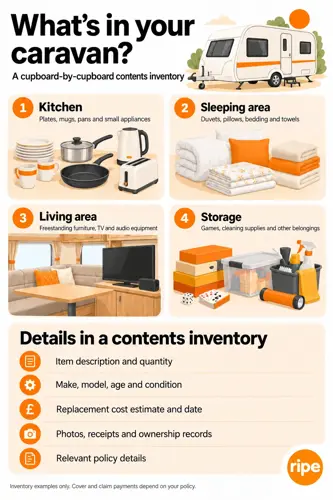
The useful part is having enough detail to revisit the figures later. Here is an example:
Item | Quantity | Replacement estimate and date checked | Policy category | Evidence |
|---|---|---|---|---|
Plates, mugs and cookware | Count sets and individual items | Add prices and date | Confirm classification | Photographs or receipts |
Duvets, pillows and towels | Count each type | Add prices and date | Confirm classification | Photographs or order records |
Freestanding furniture | List each piece | Add prices and date | Confirm classification | Receipts and photographs |
Television or audio equipment | Record make and model | Add comparable price and date | Confirm classification | Serial number and purchase evidence |
These are inventory prompts, not a schedule of insured items. Built-in furniture belongs on a separate line while you establish how the policy treats it.
If belongings are tucked under seats or behind other things, our static caravan storage ideas can help you think through the spaces you use. For valuation, the aim is simply to avoid overlooking a full cupboard.
Compare your inventory with your policy
A total gives you something concrete to work from. The next part is matching the right belongings to the right cover.
Useful points to look at together are:
Whether contents cover is selected.
The total sum insured and individual-item limits. The published Ripe touring and static contents wordings each specify a £1,000 limit per item.
The excess.
Excluded items and circumstances.
Security requirements.
How a claim would be valued.
The cost of replacing your belongings isn’t necessarily the amount an insurer would pay after a claim. Some policies provide new-for-old cover, while others base payments on an item’s value at the time, allowing for its age and condition. Limits, exclusions and the amount insured also affect what can be paid.
Depending on the policy, insuring contents for less than their value on the required basis can reduce a claim payment, even when only some belongings are lost or damaged.
The policy documents explain how belongings are valued and what cover applies. For policies arranged through Ripe, these details are in the caravan policy documents, alongside the documents showing the cover selected. There isn’t one contents figure that will suit every owner.
A contents list brings the details together: the belongings in your caravan, their estimated replacement costs and how they fit with your cover.
Frequently asked questions
How do you prove what was inside your caravan?
Receipts, photographs, valuations, manuals and guarantee cards can support ownership and value. Copies stored separately from the caravan remain accessible if the originals are lost. The claims handler may need further evidence.
Can I claim without an original receipt?
Other records may help substantiate a loss. The handler decides what evidence is needed, so neither a missing receipt nor a photograph alone settles the outcome.
Are belongings left in an awning covered?
Ripe’s touring contents wording excludes loss or theft of contents left unattended outside the caravan or from awnings. Static wording also excludes loss or damage to property left in the open. The applicable wording and circumstances matter.
Specialist caravan insurance by Ripe
Find out more about specialist caravan insurance by Ripe.
About the research
Our survey, conducted through Askable, received 50 completed responses on 14 October 2026: 74% from touring caravan owners and 26% from static caravan or lodge owners. This small sample is not representative of all UK owners. Owners could select multiple types of belongings, so the item percentages overlap. Replacement values were self-estimated, and the belongings listed were not verified as insured.
The Claims Index counts incidents reported to Ripe’s claims handlers, including rejected, withdrawn and ongoing cases as well as accepted claims. It describes Ripe’s notifications rather than national risk. Neither the index nor the survey establishes whether the owners surveyed had too little cover.
Please note the information provided on this page should not be taken as advice and has been written as a matter of opinion. For more on insurance cover and policy wording, see our homepage.