
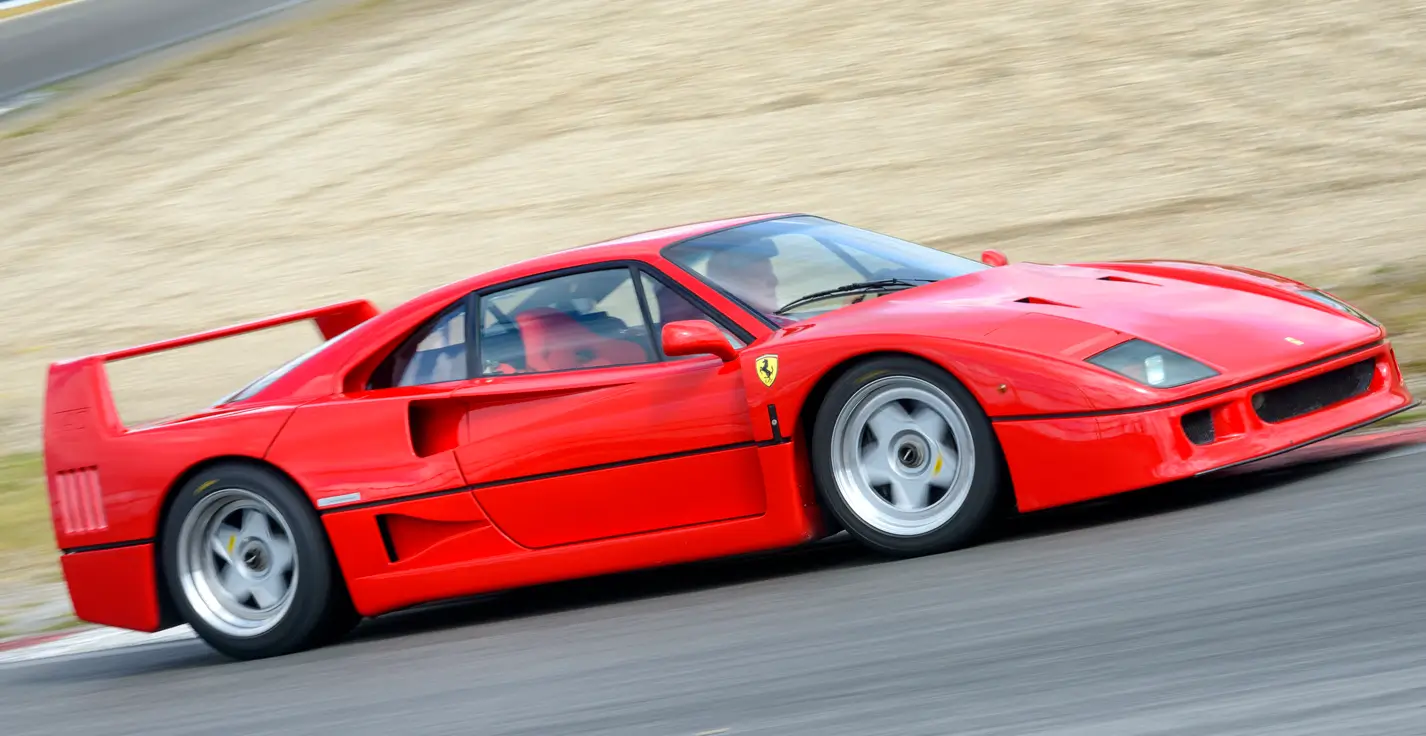
The 1980s marked a decade of groundbreaking advances in the automotive industry. A time when cars began evolving from purely mechanical machines into far more sophisticated vehicles shaped by emerging technologies. Manufacturers were no longer content with traditional, analogue designs and instead pushed toward a new era of high-tech engineering. This shift brought the integration of electronic systems, fuel injection and turbocharging. It transformed not only how cars were built, but also how they performed and were experienced on the road.
To get a little nostalgic and find some inspiration for your own classic car collection, here we’ll take a look at four of the most iconic cars of the 1980s.
1. Ferrari F40
It really doesn’t get more iconic than this. The Ferrari F40 was introduced in 1987 to celebrate Ferrari’s 40th anniversary. And it was also the last car approved by Enzo Ferrari, adding a layer of historical significance to this incredible machine.
It’s easy to describe this car as stripped back. It didn’t have power steering, traction control or anti-lock brakes. But what it did have was unbelievable horsepower for the period. Its twin-turbocharged 2.9-litre V8 engine produced around 471 horsepower. This meant it could reach speeds of 200mph, making it one of the fastest road cars of its era.
When the F40 first launched in the 80s, it sold for around £163,000. It became so popular that demand outdid supply and some were selling for over a million pounds. It’s no surprise that it’s one of the most valuable and sought-after Ferraris ever made.
2. Volkswagen Golf GTI
Unlike many sports cars of the 1980s, which often relied on bold styling and loud designs, the Volkswagen Golf GTI took a very different approach. It didn’t try to stand out through flashiness or excess. Instead, it embraced a clean, understated look that felt modern, practical and quietly confident.
At first glance, the GTI could easily be mistaken for a standard everyday car. But that was part of its appeal. Beneath its simple design was a car that delivered an engaging and enjoyable driving experience. It handled smoothly, felt responsive on the road, and offered a level of performance that made even short journeys more interesting.
Just as importantly, the GTI built a strong reputation for reliability. Owners knew they could depend on it for daily use without the constant worry of breakdowns or high maintenance costs. This combination of fun and dependability made it especially appealing to a wide range of drivers.
Young drivers were drawn to the GTI because it offered excitement without being out of reach financially. Small families, on the other hand, appreciated its practicality, affordability and ease of ownership. It was a car that could fit into everyday life while still feeling a little bit special.
In the UK, a new GTI typically cost around £7,000 to £9,000 depending on the model and year. Earlier 8 valve versions were on the lower end of that range, while later 16 valve models that promised more power and extra features increased the price.
3. Porsche 959
The Porsche 959 was originally conceived as a rally car, but it ultimately evolved into a groundbreaking road machine. Powered by a 2.85-litre twin-turbocharged flat-six engine, it produced around 450 horsepower. This was enough to propel it to a top speed of roughly 197 mph. In the mid-1980s, that performance placed it among the fastest production cars in the world.
What truly set the 959 apart was its advanced All Wheel Drive system, known as Porsche-Steuer Kupplung (PSK). This innovative setup could dynamically vary power distribution between the front and rear wheels based on driving conditions, giving the car exceptional versatility. Whether on wet roads, dry pavement or loose surfaces, it maintained impressive grip and control. This was something that was remarkably advanced for a road car in the 1980s.
The 959 also incorporated a range of groundbreaking technologies that made it well ahead of its time. This included an adjustable suspension system that allowed drivers to alter the ride height to suit different driving conditions, enhancing both comfort and capability.
To further improve performance and efficiency, the car made extensive use of lightweight materials such as aluminium, Kevlar, and advanced composites, resulting in a significantly reduced overall weight. Plus, it featured sophisticated electronics for the era, including early forms of traction control and onboard diagnostics. It offered a greater level of control and insight than most other cars of the time.
Only 292 examples of the Porsche 959 were ever produced, making it exceptionally rare. Despite its high price tag – around £145,000 in the 1980s – Porsche reportedly lost money on each car due to the immense cost of developing and building its advanced technology. Today, values have surged dramatically, with prices typically ranging from £1.2 million to £2.5 million, depending on the specific model and condition.
4. Peugeot 205 GTI
One of the most defining hot hatches of the 1980s, the Peugeot 205 GTI combined a lightweight, compact design with sharp handling and lively performance. Available with either a 1.6 or 1.9 litre engine, it delivered a punchy, responsive drive that made it feel quick and agile on the road. What truly set it apart, however, was its ability to balance everyday practicality with genuine driving enjoyment. It’s a car that was just as suitable for daily use as it was for fun days out.
When the Peugeot 205 GTI was first introduced in 1984, it was considered relatively affordable for a performance-focused car, with an initial price of around £6,245. Later that same year, the price crept up slightly to approximately £6,645 as demand grew and minor updates were introduced.
With the arrival of the more powerful 1.9 GTI version a few years later, the cost shot up more noticeably. Prices typically ranged from about £9,000 to £9,930 depending on the exact specification and optional extras. This positioned it competitively within the hot hatch market, offering strong performance without straying too far beyond the reach of enthusiastic buyers.
The 80s – An incredible time for cars
In many respects, the 1980s transformed what people expected from their cars. It was a period where bold ideas and advancing technology came together, resulting in vehicles that were not just quicker and more capable but also increasingly sophisticated and refined.
From the raw, unfiltered performance of the Ferrari F40 and the cutting-edge engineering of the Porsche 959 to the everyday practicality of the Volkswagen Golf GTI and the lively Peugeot 205 GTI, each model captured a unique aspect of this dynamic and influential decade.
Specialist classic car insurance through Ripe
As well as considering the costs of owning, maintaining, and storing a classic vehicle, you might also want to consider specialist classic car insurance by Ripe for financial protection if the unexpected happens.
Ripe arranges cover designed specifically for classic car owners, helping to protect vehicles against risks such as theft, loss, accidental damage, fire, and vandalism, so you can enjoy your pride and joy with added peace of mind, get an online quote today.
Please note the information provided on this page should not be taken as advice and has been written as a matter of opinion. For more on insurance cover and policy wording, see our homepage.